Scoliosis is one of those diagnoses that tends to produce a lot of anxiety and, unfortunately, a lot of misinformation. Patients are often told either that nothing can be done, or that chiropractic will fix it entirely. Neither is accurate. As someone who has managed scoliosis patients for over 30 years, I want to give you an honest picture of what scoliosis actually is, how it's assessed, and what a realistic management approach looks like.
What is scoliosis?
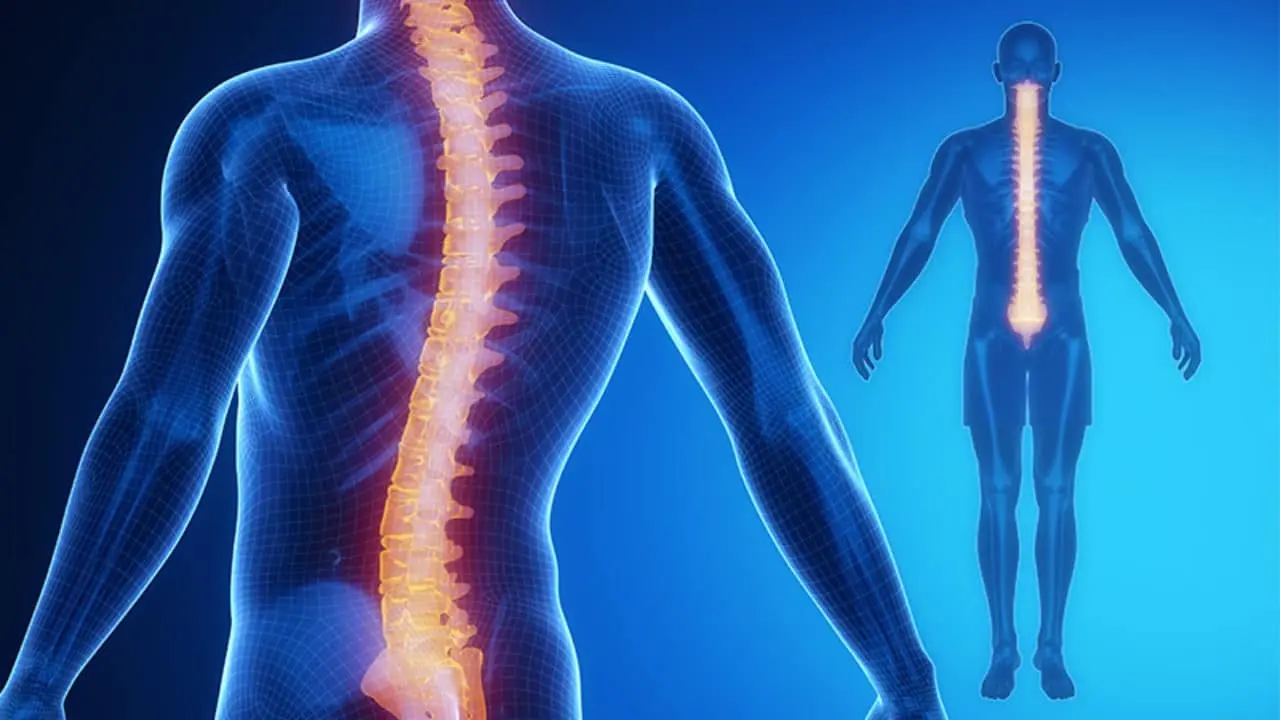
Scoliosis is an abnormal lateral curvature of the spine. Where a healthy spine viewed from behind should be straight, a scoliotic spine curves to the side — sometimes forming a single "C" curve, sometimes a double "S" curve involving both the thoracic and lumbar regions.
The severity of a scoliotic curve is measured in degrees using the Cobb angle — the angle between the most tilted vertebrae at the top and bottom of the curve on an X-ray. Curves are generally classified as:
- Mild: less than 20 degrees
- Moderate: 20–40 degrees
- Severe: greater than 40 degrees
The degree of curve matters because it drives management decisions — mild curves are typically monitored and managed conservatively, while severe curves may require specialist review for bracing or, in some cases, surgical consideration.
Types of scoliosis
Idiopathic scoliosis
The most common form, accounting for around 80% of all scoliosis cases. "Idiopathic" simply means the cause is unknown. It's most commonly diagnosed during adolescence — particularly in girls during the growth spurt between ages 10 and 15 — which is why school screening programmes exist. Adolescent idiopathic scoliosis doesn't necessarily worsen after skeletal maturity, but it does need to be monitored during growth.
Adult degenerative scoliosis
Also called de novo scoliosis, this develops in adults — typically from the mid-50s onwards — as a result of asymmetric degeneration of the intervertebral discs and facet joints. Unlike adolescent scoliosis, it tends to present with significant back pain and can progress gradually. It's increasingly common as the population ages, and it's something I see regularly in clinical practice.
Congenital scoliosis
Caused by malformation of the vertebrae during foetal development. Present from birth. Less common and typically requires specialist orthopaedic management.
Neuromuscular scoliosis
Associated with neurological or muscular conditions such as cerebral palsy, muscular dystrophy or spina bifida. The curve results from muscle imbalance or weakness. Management is closely tied to the management of the underlying condition.
How do you know if you have scoliosis?
Mild scoliosis is often completely painless and picked up incidentally — on a school screening, during a physical examination for something else, or on imaging taken for another reason. More significant curves may produce visible postural changes or symptoms.
Common signs and symptoms
- Uneven shoulders — one shoulder sitting higher than the other
- Uneven hips — one hip appearing more prominent or elevated
- A visible curve in the spine — often more apparent when bending forward (the Adam's forward bend test)
- Rib prominence — a "rib hump" on one side when bending forward, caused by vertebral rotation accompanying the lateral curve
- Back or rib pain — particularly in adults and in larger curves
- Muscle fatigue — the muscles on one side working harder to compensate for asymmetric loading
- In severe cases: reduced lung capacity, breathing difficulties, or nerve symptoms into the legs
Definitive diagnosis requires imaging. If I suspect scoliosis during a postural or spinal assessment, I will refer for X-ray to confirm the diagnosis, measure the Cobb angle, and identify the pattern and location of the curve before proceeding with any treatment plan.
What chiropractic can — and can't — do for scoliosis
I want to be straightforward here, because this is an area where patients sometimes receive misleading information.
What chiropractic cannot do
Chiropractic cannot straighten a structural scoliotic curve. A curve that has developed as a result of vertebral asymmetry, disc degeneration or skeletal growth patterns is not going to be reversed by spinal manipulation. Anyone who tells you otherwise is not being honest with you. In severe curves that are progressing, specialist orthopaedic review — including consideration of bracing or surgery — may be the appropriate path, and I will refer accordingly.
What chiropractic can do
What conservative chiropractic care can meaningfully achieve in appropriate scoliosis patients includes:
- Pain management — reducing the muscular pain, joint irritation and tension that accompany scoliosis, particularly in adults with degenerative scoliotic curves
- Improved mobility — restoring as much spinal movement as possible and reducing stiffness through targeted adjustments and soft tissue work
- Postural support — identifying and addressing secondary postural compensations that develop above and below the curve and contribute to pain and fatigue
- Slowing functional decline — particularly in adult degenerative scoliosis, maintaining function and managing symptoms can meaningfully improve quality of life and slow deterioration
The role of clinical Pilates in scoliosis management
This is where I see some of the most meaningful results in scoliosis patients. Clinical Pilates — prescribed and supervised by a clinician, not a generic class — can build the deep spinal stabilising muscles that support an asymmetric spine.
In a scoliotic spine, the muscles on the concave side of the curve tend to be shortened and the muscles on the convex side tend to be lengthened and weakened. Over time, this asymmetry perpetuates the postural changes and contributes to pain. A targeted exercise programme can address these imbalances, improve core stability, and help patients maintain better spinal control in their daily activities.
I prescribe clinical Pilates for scoliosis patients not as a cure, but as a core component of a long-term management strategy. Combined with hands-on care to manage pain and mobility, it gives patients genuine tools to manage their condition actively rather than passively.
When to seek further assessment
I would encourage anyone with a known or suspected scoliosis to seek proper assessment if:
- You are a child or teenager and a curve has been identified — monitoring during growth is important
- You have noticed increasing pain or worsening of your curve over time
- You have a known curve but have never had it properly measured or monitored
- You are experiencing nerve symptoms — numbness, tingling or weakness in the legs — associated with your back
- You have been told your curve is greater than 40 degrees and have not seen an orthopaedic specialist
A thorough assessment is always the starting point. Understanding exactly what type of scoliosis you have, where the curve is, how significant it is, and what is driving any symptoms is essential before any management plan can be developed. That assessment is something I am well-placed to provide — and if what I find indicates that specialist input is needed, I will refer you.