What is sciatica?
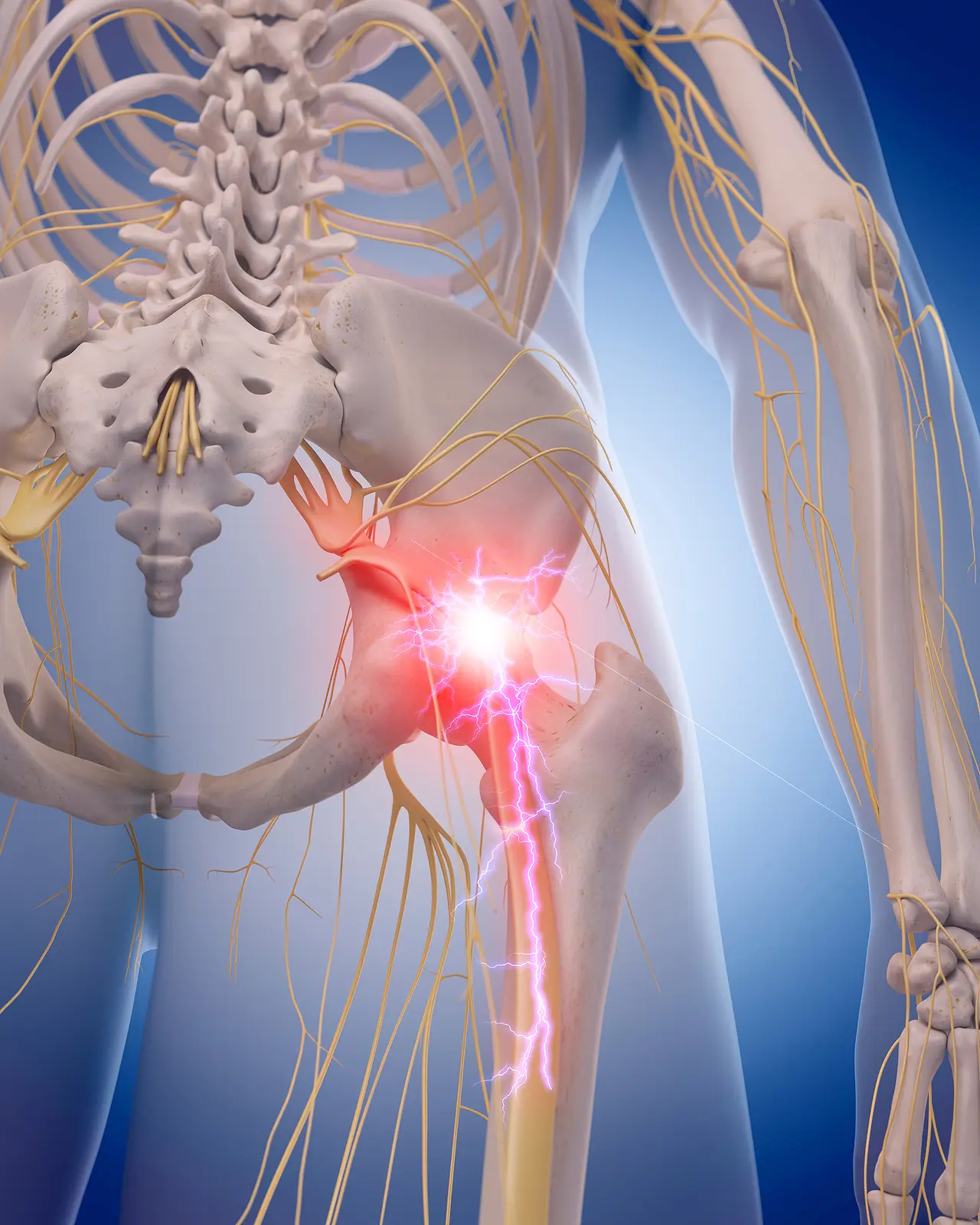
Sciatica is not a diagnosis in itself — it's a symptom. It describes pain that follows the path of the sciatic nerve, which runs from the lower back through the buttock, down the back of the thigh and into the lower leg and foot. The pain can present as a sharp ache, a burning sensation, an electric shock-like feeling, or a combination of all three.
In addition to pain, sciatica often involves numbness, tingling and weakness in the leg — symptoms that reflect the fact that the sciatic nerve is being compressed or irritated at its origin. Sitting, bending forward, coughing and sneezing often aggravate it. In severe cases, even lying down provides little relief.
Identifying the specific cause of the nerve compression is the critical first step — because treatment needs to be directed at the underlying mechanical problem, not just the pain itself.
Common causes of sciatica
Disc Bulge or Herniation
The most common cause of sciatica. When the inner material of an intervertebral disc protrudes through the outer fibrous ring, it can press on the adjacent nerve root as it exits the spinal canal. Disc-related sciatica often presents with pain and neurological symptoms (numbness, tingling, weakness) following a specific dermatomal pattern corresponding to the affected nerve root. The L4-5 and L5-S1 disc levels are most commonly involved. Most disc-related sciatica can be managed conservatively, and many people improve without needing surgery.
Piriformis Syndrome
The piriformis muscle sits deep in the buttock and, in most people, the sciatic nerve passes directly beneath it. When the piriformis becomes tight, inflamed or in spasm — from overuse, prolonged sitting or direct trauma — it can compress the sciatic nerve, producing buttock and leg pain that mimics disc-related sciatica but has a different origin. Piriformis syndrome is often underdiagnosed and responds particularly well to targeted soft tissue therapy, stretching, laser therapy and addressing the underlying biomechanical contributors.
Spinal Stenosis
Spinal stenosis refers to narrowing of the spinal canal — usually from degenerative changes including disc degeneration, facet joint hypertrophy and ligament thickening. It is more common in older patients and tends to produce bilateral leg pain that is worse with walking and standing, and relieved by sitting or forward bending. Chiropractic care may help with meaningful symptom relief and functional improvement for many patients with lumbar stenosis, particularly when combined with appropriate exercise.
Sacroiliac Joint Dysfunction
The sacroiliac joint (SIJ) is located at the junction of the sacrum and the ilium in the posterior pelvis. SIJ dysfunction can produce lower back, buttock and posterior thigh pain that closely mimics sciatica. It is a frequently overlooked contributor to sciatic-type symptoms and requires specific assessment techniques to identify. Treatment targeting the SIJ — chiropractic manipulation, specific exercises and activity modification — can produce excellent outcomes.
Lumbar Spondylosis
Age-related degenerative changes in the lumbar spine — including disc degeneration and facet joint arthritis — can narrow the foraminal openings through which nerve roots exit the spinal canal. This foraminal stenosis can irritate or compress the emerging nerve roots, producing sciatic-type symptoms. Chiropractic care that mobilises the affected segments and reduces local inflammation can meaningfully reduce symptoms and improve function in spondylotic sciatica.
Spondylolisthesis
Spondylolisthesis is the forward slippage of one vertebra on another. When this slippage is sufficient to compress or stretch the adjacent nerve roots, it can produce sciatica-type symptoms. Conservative chiropractic management can be appropriate for mild to moderate degrees of spondylolisthesis, with the aim of reducing local irritation, improving surrounding muscle support and managing symptoms. Imaging is typically required to confirm the diagnosis and grade of slippage.
How we approach sciatica at Momentum
Effective sciatica management requires identifying the specific mechanical cause of the nerve compression — and then directing treatment at that cause. Dr Poulton begins with a comprehensive assessment including a detailed history, neurological testing to identify the affected nerve root level, and movement and structural analysis to identify the likely mechanical origin.
Treatment typically involves:
- Spinal adjustments — targeting the mechanical dysfunction at the level identified in the assessment
- Soft tissue therapy — releasing the surrounding muscles, including piriformis and hip external rotators where appropriate
- Laser therapy — reducing inflammation around the affected nerve root and adjacent soft tissues
- Prescribed exercises — specific movements designed to decompress the nerve, stabilise the lumbar spine and address the biomechanical contributors
- Activity modification — guidance on positions and movements to avoid during recovery, and how to manage activities of daily living safely
Referral for imaging is arranged when clinically indicated — particularly for patients with significant neurological deficits, progressive symptoms or presentations that may require surgical consultation.
Sciatica FAQ
Can chiropractic help sciatica?
Yes, in most cases. Chiropractic care has good clinical evidence for managing sciatica, particularly disc-related and SIJ-related presentations. By addressing the mechanical cause of the nerve compression — rather than simply managing symptoms — chiropractic care can help achieve genuine, lasting improvement. The key is accurate diagnosis first, to ensure the treatment is appropriately targeted.
How long does sciatica treatment take?
Sciatica can take longer to resolve than simple back pain, because nerve healing is slower than muscle and joint healing. Recovery often takes 8–12 weeks or more, depending on severity. Dr Poulton will give you a realistic timeline based on your specific presentation at the initial assessment.
What does sciatica feel like?
Sciatica typically presents as pain that travels from the lower back or buttock into the leg — often described as sharp, burning, electric or shooting. Numbness, tingling and weakness in the leg are also common. The pain is often worse with sitting, bending forward, coughing or sneezing. In severe cases, finding a comfortable position is very difficult.
Is it safe to have a chiropractic adjustment with sciatica?
Yes, in the appropriate clinical context. Dr Poulton assesses every patient thoroughly before treating, including neurological testing to identify the nature and severity of any nerve involvement. Adjustments for sciatica patients are applied specifically to the mechanical level identified, using appropriate technique and force — always prioritising the safety and comfort of the patient.
Do I need a referral?
No. You can book directly. Medicare EPC, TAC and WorkCover patients are also welcome.
Does laser therapy help sciatica?
Yes. Low-level laser therapy can be particularly helpful for sciatica presentations where inflammation around the nerve root or surrounding soft tissues is a significant contributor. By helping to reduce inflammatory mediators at the cellular level, LLLT may help ease pain alongside the mechanical treatment.